
Phenyl Trimethicone vs Dimethicone: Separate Clarity from Film Gloss
Compare phenyl trimethicone and dimethicone by phase-index matching, transmitted clarity and surface gloss. Keep grade evidence and finished-formula decisions separate.
Put phenyl trimethicone on the shortlist when a formulation has a defined optical-index or appearance problem to solve, not simply because a description says high gloss. First decide whether the target is light passing through the product or light reflected from its applied surface. Those are different selection problems, and a higher raw-fluid refractive index does not automatically improve both.
MOS lists separate phenyl trimethicone and dimethicone materials. Their catalogue identities provide a route to request actual grades; they do not establish a universal substitution rate or a measured gloss advantage.
Identify the ingredient before choosing the optical effect
Dimethicone denotes linear polydimethylsiloxane grades. Phenyl trimethicone is a different silicone ingredient containing phenyl functionality. The complete INCI declaration still matters: a phenyl-functional marketing name does not identify every component of a supplied blend.
Dow's SH 556 technical sheet identifies Phenyl Trimethicone and reports typical optical and viscosity properties for that named material. Its figures are not specification-writing values and are not MOS grade specifications. Dow's skin-care portfolio also lists a different high-refractive-index silicone, PH-1555 HRI, as Trimethyl Pentaphenyl Trisiloxane. Do not transfer its ingredient identity or properties to phenyl trimethicone.
For a proposed sample, establish the full ingredient declaration, whether it is a neat fluid or blend, and viscosity with method and temperature. A viscosity difference can alter spreading and film formation, complicating any claim that an observed change came from optical properties alone.
Choose the direction of the optical change
Dow's hair and skin-care selection guide gives a useful, limited reason to consider a phenyl candidate: its named 556 Phenyl Trimethicone has a typical refractive index of 1.460, while the listed PMX-200 20 cSt Dimethicone has 1.401. These are manufacturer examples for different grades, not MOS specifications or a controlled comparison of finished-film gloss. They justify investigating an optical difference; they do not qualify a substitution.
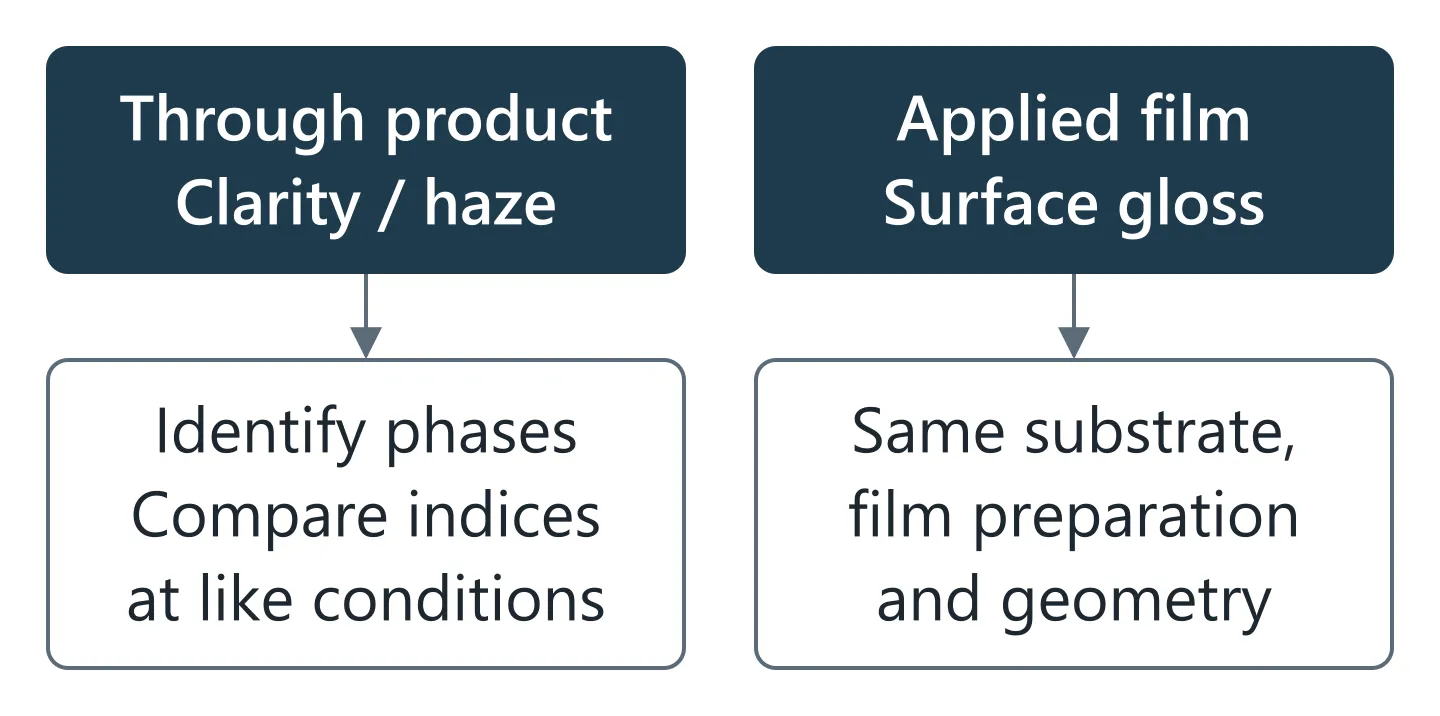
If the goal is transparency through the product
Light can scatter at boundaries between phases with different refractive indices. The cosmetic-science study Refractive index matching and clear emulsions discusses reducing that contrast to produce clear emulsions and reports deviations between calculated and measured mixture indices. The practical first step is to identify the actual phases and measure their relevant indices under comparable conditions, rather than choose the ingredient with the largest number.
If one phase needs a higher index to approach the other, a suitable higher-index fluid may be worth screening. If the other phase has a lower index, raising the oil-phase index can move away from the intended match. This direction check matters before changing a formulation. It supplies no universal blend ratio, and actual mixing, temperature, dispersed material and absorption still affect appearance.
Optical matching also does not mean molecular miscibility. A transparent emulsion remains an emulsion. A clearer blend therefore needs its own phase and stability assessment; appearance alone cannot establish a single homogeneous phase or shelf life.
If the goal is gloss at the applied surface
Gloss concerns reflected light in a defined viewing or measurement geometry. BYK-Gardner's gloss measurement white paper distinguishes material, surface texture, illumination and substrate effects. A change in refractive index can be relevant to reflection, but it does not remove those other variables. A smoother film and a rougher film cannot be ranked from their ingredient indices alone.
Keep transmitted clarity, surface gloss and reflection haze as distinct observations. If an instrument reports gloss units, record the geometry and method; those units are not simply the percentage of incident light reflected. Select an assessment appropriate to the actual cosmetic surface rather than assuming a flat coating-panel method covers skin or hair.
Use the following distinction to decide what evidence to collect. This is a proposed qualification framework, not comparative MOS test data.
| Optical goal | Selection check that can change the candidate | Interpretation boundary |
|---|---|---|
| Change the liquid phase's refractive index | Compare the actual grades under stated optical conditions against the required direction of change | A higher number is not a universal improvement |
| Reduce transmitted haze | Establish which phases or dispersed materials produce the contrast, then assess the actual formulation | A clear appearance does not prove molecular miscibility or stability |
| Increase the required surface gloss | Compare prepared films with comparable surface, substrate, application and measurement geometry | Raw-fluid index or bulk clarity is not a finished-gloss result |
A high-index fluid cannot be assumed to clear an arbitrary cloudy formulation. A neat oil blend, a pigmented dispersion and an emulsion present different optical questions. Diagnose the actual system before treating a silicone-family change as the solution.
Run the comparison without hiding a second formulation change
Keep the accepted formula as the reference. Identify the actual candidate grade and the specific change being tested. Record the silicone addition basis and all other changes, including a different carrier or an auxiliary ingredient introduced with a supplied blend.
Screen the intended liquid blend at defined compositions and temperatures. Record initial appearance and the observations after agreed conditioning or storage. If the blend separates or becomes unacceptable, resolve that result before interpreting an attractive fresh film as a successful replacement.
Assess the applied product separately. Hold the substrate, application amount or film thickness, preparation, conditioning and viewing or instrumental method comparable. For hair, skin-product or colour-cosmetic use, select a suitable application-specific evaluation rather than treating one glass drawdown as proof of every benefit.
If several ingredients or processing conditions change together, the trial can qualify that new formula, but it does not isolate phenyl substitution as the cause. If viscosity cannot be matched, report the difference rather than disguising it as an equal-grade optical comparison. A promising appearance result then moves to the remaining stability, packaging and applicable product assessments; it does not replace them.
Specify the decision your sample must support
Request the phenyl trimethicone candidate or dimethicone grade against the actual formula and intended function. Include the current material, full ingredient needs, supplied form, viscosity conditions, process, target appearance and comparison plan. State sample and order quantities, packaging and destination, and request current TDS/SDS and agreed lot documentation.
The useful purchasing outcome is an identified grade that passes separate blend and finished-product criteria. Neither an ingredient name nor a clear raw-fluid sample is a complete appearance specification.