
Sodium Methyl Cocoyl Taurate: Powder vs Liquid Dosing
Replacing liquid sodium methyl cocoyl taurate with powder by equal supplied weight changes more than handling. It can change active surfactant dosage, added water and the contribution of salts or other ingredients. Select the form around the complete formulation and manufacturing
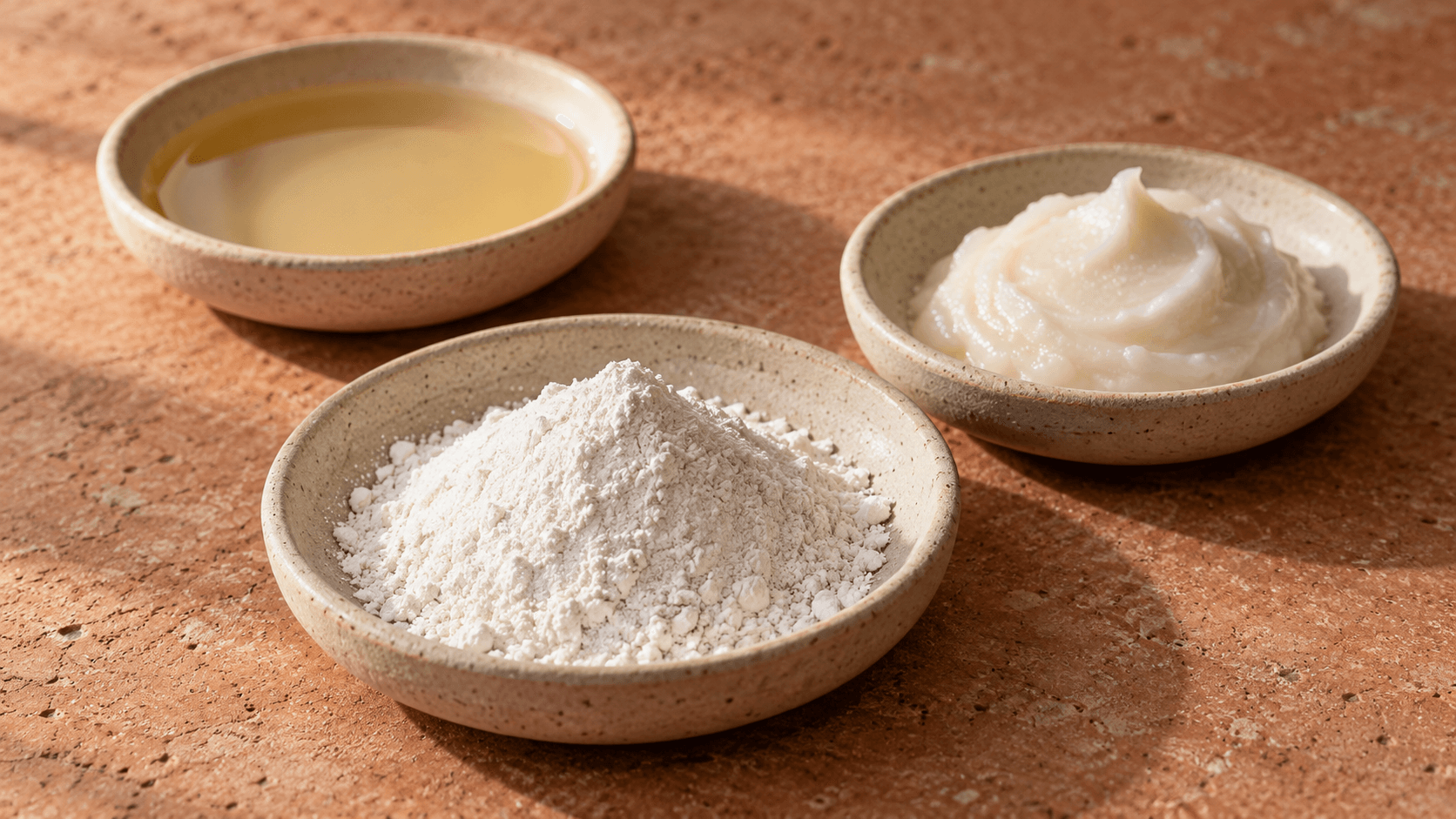
Replacing liquid sodium methyl cocoyl taurate with powder by equal supplied weight changes more than handling. It can change active surfactant dosage, added water and the contribution of salts or other ingredients. Select the form around the complete formulation and manufacturing process, then calculate the substitution from the actual offered grades.
The INCI name does not define the supplied concentration
MOS has separate powder, clear-liquid and paste Product records. These identify supplied forms, not three universally interchangeable formulations. Innospec's product guide likewise lists different commercial forms under sodium methyl cocoyl taurate, and Clariant describes a paste product. Their compositions belong to those manufacturers; they are not MOS assay values.
The current MOS powder overview declares solids ≥95%, active matter ≥93.5% and sodium chloride ≤1.5%. These are separate specification statements. Solids are not synonymous with active surfactant, and a minimum active specification is not the measured active fraction of every batch. The liquid and paste records reviewed here do not provide a verified active-matter percentage suitable for this calculation. Request it rather than assuming a standard market concentration.
Calculate equal-active dosage, then close the water balance
For the same final batch mass, let d₁ be the supplied dosage of the current grade and a₁ its verified active fraction. For a candidate with active fraction a₂, the equal-active supplied dosage is d₂ = d₁ × a₁ / a₂. Use the same units for both dosages and fractions. This is a mass-balance calculation, not evidence of equivalent foam, mildness or viscosity.
Next account for the water and non-active components contributed by each grade. Less supplied powder than liquid generally leaves a different amount to make up, but not every non-active component is water: salts, carriers or co-ingredients must be identified. Do not convert all non-active material into added water. Recheck the complete batch total and the formula's electrolyte balance.
If only a minimum assay is available, the calculation remains a planning bound rather than a verified batch recipe. Ask for the actual COA or agreed formulation-control basis before production. Never treat the powder's declared lower limit as proof of the liquid's concentration.
Powder, liquid and paste create different handling questions
| Supplied form in the MOS record | Practical question before substitution | What the form alone cannot prove |
|---|---|---|
| White powder | Addition, wetting and complete dissolution under an approved process | Actual batch assay or immediate dissolution |
| Pale transparent liquid; low-temperature crystals may occur | Storage condition, recovery procedure and appearance at intended handling temperature | Permanent clarity of the finished cleanser |
| White to pale-yellow emulsion or paste | Transfer, dispersion and incorporation into the actual formula | Equal viscosity, foam or mildness at equal supplied weight |
The catalogue's low-temperature crystal note is a reason to agree handling and recovery with the supplier. It is not a universal heating instruction or permission to use a material outside its approved conditions. For powder, distinguish incompletely wetted particles from a final-formula stability problem before increasing mixing or temperature.
Approve the final formula, not only the raw-material appearance
Make a reference batch and an equal-active candidate batch with documented water adjustment. Keep other deliberate variables, mixing history and test conditions controlled. Record incorporation and dissolution first; then evaluate final appearance, pH under the same method, viscosity at a defined temperature and procedure, foam in the relevant use test, and stability under an agreed program.
A clear raw material can produce a hazy or viscous final system when combined with other ingredients. A successful fresh appearance check does not prove storage stability, preservative performance or skin compatibility. These require the applicable finished-product assessment; neither INCI identity nor a supplier's mildness wording replaces it.
Request the two grades on a comparable basis
Start with the powder-grade enquiry and specify which liquid or paste it would replace. Send the current dosage and verified assay, target active matter, water and electrolyte constraints, cleanser format, incorporation process, acceptance tests, sample quantity, order volume, packaging and destination. Request current grade-specific TDS/SDS, COA/active assay and relevant composition and handling information. This lets the supplier compare a real substitution instead of quoting on the assumption that identical INCI means identical performance.
Sources: Innospec personal-care product guide and Clariant Hostapon CT paste information. External grade examples establish form diversity only; no external active percentage or performance claim is transferred to MOS.