
Sodium PCA vs Zinc PCA: Qualify the Salt and Supplied Form Before Substitution
Compare PCA salt identity, supplied assay and controlled formula evidence before substituting sodium PCA or zinc PCA. Clarity is not proof of stability.
Sodium PCA and zinc PCA share the PCA name, but they are different salts—not two interchangeable descriptions of the same ingredient. Sodium PCA is used as a humectant; zinc PCA introduces a different ingredient identity and a different formulation question. A purchasing decision should therefore start with the intended function and the actual supplied material, not an equal-weight substitution or a benefit comparison copied from a catalogue.
The useful question is: which material, on which analytical basis, can meet this formula's intended endpoint without creating a new compatibility problem? A clear premix is one observation. It does not establish finished-product stability, skin performance or preservation.
Specify the material before comparing the function
Ask for the ingredient identity and the offered grade before comparing addition levels. The name “PCA” does not specify the counterion, the supplied concentration or whether an assay is reported on an as-supplied or another stated basis. A liquid product and a powder cannot be compared simply by weighing the same amount; even a known active-content correction does not establish that two different salts perform equivalently.
Ajinomoto's separate AJIDEW sodium-PCA and zinc-PCA product information illustrates the need to identify the actual ingredient and commercial form. Those manufacturer's grades are references, not specifications for a MOS shipment. The MOS catalogue provides separate sodium PCA and zinc PCA enquiry routes. Neither a page name nor another supplier's grade establishes the assay, incorporation procedure or efficacy of the material offered for your order.
| Qualification question | Evidence to keep | Decision it supports |
|---|---|---|
| Is the chemical ingredient actually the one requested? | Ingredient name, salt identity and current grade documentation | Prevent a shared acronym from becoming an unintended substitution |
| What does the supplied quantity contain? | Physical form, stated assay and reporting basis; solvent or carrier where applicable | Calculate an addition on its declared basis, without assuming functional equivalence |
| Will it incorporate under the proposed conditions? | Grade-specific dissolution guidance and a recorded small-scale trial in the intended formula | Distinguish a material or incorporation issue from later formula changes |
| What must the finished product achieve? | A defined physical and intended-function endpoint, assessed by appropriate methods | Avoid accepting clarity, a catalogue claim or another formula's result as proof of suitability |
If the current offered form or analytical basis is missing, the addition calculation is not ready. Do not fill that gap with the concentration of a familiar commercial grade.
Separate a mixing problem from a formula result
Keep an unchanged reference formula and evaluate the candidate material with a documented addition basis. Record the starting formula, water quality, actual addition sequence, mixing and temperature history, pH measurement conditions and observation times. Keep these conditions matched where the comparison permits. If the candidate requires a different incorporation step, document that as a second variable rather than attributing every difference to the salt.
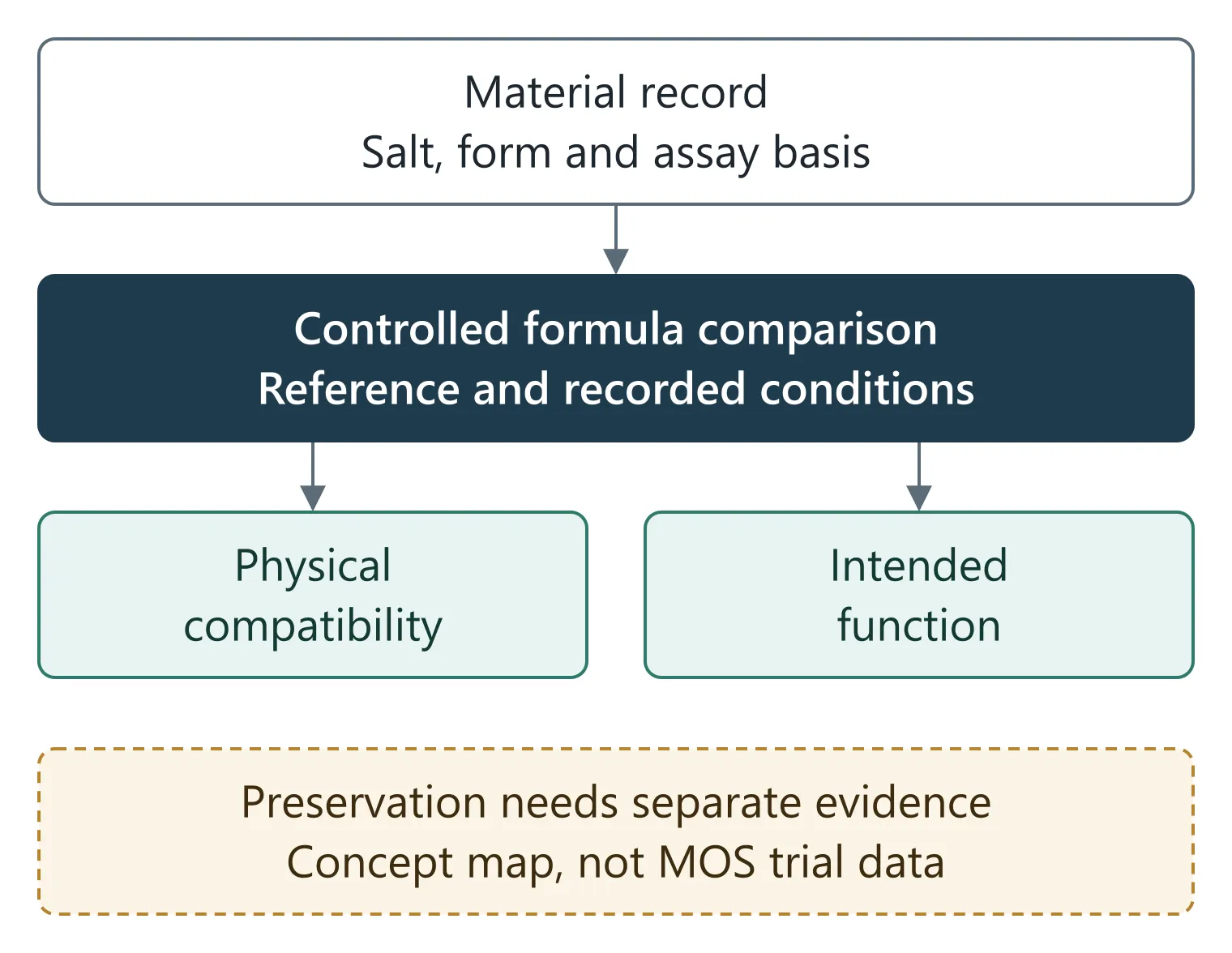
An initial failure to dissolve first calls for checking identity, assay, the supplier's incorporation guidance and the actual mixing conditions. It does not by itself prove that the ingredient is unsuitable for every cosmetic system. Conversely, a clear ingredient solution does not predict how it behaves alongside the formula's other ingredients.
Haze, sediment, separation or a viscosity change after addition is a signal to investigate—not a diagnosis of a particular chemical reaction. Compare the unchanged reference and the candidate batch under the same observation conditions. Where necessary, run a separate, controlled comparison of the suspected process or pH change. Changing the salt, water, process and pH together makes the result difficult to interpret. Do not call a visually acceptable sample “stable” without the agreed evaluation conditions and period.
Physical compatibility and intended function also need different evidence. A formula can remain uniform yet miss its target function; a claimed ingredient function cannot compensate for unacceptable physical change. The relationship diagram separates those questions deliberately. It is a qualification map, not a report of a MOS experiment.
Approve the change against the intended endpoint
Choose sodium PCA when the brief calls for its documented humectant role and the actual grade can be qualified for that formula. Investigate zinc PCA when its different ingredient role is relevant to the brief, with supporting grade and finished-formula evidence. Do not select it merely because a zinc-containing name sounds like a stronger version of sodium PCA, or assume either salt replaces the other at the same dose.
Keep the change on technical hold if the material identity or supplied basis is unresolved, the reference and candidate were not compared on interpretable conditions, an unexplained physical change remains, or the claimed finished-product endpoint has not been evaluated. These are different reasons to stop, and they require different follow-up evidence.
Preservation remains a separate decision. Zinc identity, a supplier's ingredient claim or a clear sample does not prove that the final formula is adequately preserved. The preservative challenge-test guide explains why preservation efficacy and a microbial-limits result answer different questions; verify the appropriate test plan for the actual product.
For a MOS ingredient enquiry, identify the required salt and offered form, intended formulation, analytical basis, sample or order quantity and destination. Request the current grade documentation through the relevant product page. A useful supplier response resolves those specific uncertainties; it does not replace controlled formula qualification or justify an untested performance claim.